
How to Get Skagit Court Records
Superior records come from the Skagit County Clerk. Search free Odyssey case data, view eligible images at a lobby kiosk or through a paid subscription, ask by phone or email, visit the counter, or mail a request. District Court and each municipal clerk fulfill their own case requests. Washington Case Search and JIS-Link can locate an index but do not hold documents.
- Locate the case and court of record.
- Name the exact docket, pleading, order, judgment, recording, or transcript.
- Choose Odyssey, kiosk, email, phone, mail, or the clerk's counter.
- Provide case number, title, filing date, and party name.
- Approve the quoted fee and request plain or certified form.
Administrative records use GR 31.1 and the county public-records portal. That process is separate from a judicial case file governed by GR 31. Mail requests for Superior records go to 205 W. Kincaid Street, Room 103, Mount Vernon, WA 98273. The clerk also publishes supcrtclerk@co.skagit.wa.us and 360-416-1800. Ask for the total and processing time before sending payment because the office does not promise one universal turnaround.
Skagit Index, Document, or Copy
These products are not interchangeable. An index lists events and documents. A filed document contains the actual text. A certified copy bears the clerk's official certification. An authenticated or exemplified record involves more than ordinary certification.
| Product | Shows | Source |
|---|---|---|
| Case index | Parties, status, entries | Portal or clerk |
| Filed document | Exact pleading or order | Kiosk, subscription, clerk |
| Certified copy | Official clerk-issued copy | Court clerk |
Use the index to identify the precise document before paying for a copy.
Types of Skagit Court Records
The County Clerk maintains Superior civil, adult criminal, domestic, probate, and guardianship records. District Court holds county limited-jurisdiction criminal, traffic, civil, and small-claims files. Municipal courts keep their city dockets.
- Case indexes and docket sheets
- Pleadings, motions, declarations, and exhibits
- Orders, judgments, and dispositions
- Public criminal, civil, family, probate, and guardianship records
- Audio, video, and transcripts where available
A transcript is usually ordered from the court reporter or transcriber, not copied from the electronic docket. Ask the clerk which person recorded the proceeding.
The custodian follows the court, not the county name alone. Melissa Beaton's County Clerk office keeps Superior civil, adult criminal, domestic, probate, and guardianship files. District Court administration keeps county limited-jurisdiction criminal, traffic, civil, and small-claims records. Each municipal clerk keeps that city's ordinance, traffic, and misdemeanor file. A statewide JIS display can point to the right court, but it does not move custody of the document.
Skagit Kiosk or Odyssey Subscription
Skagit Superior provides free case data through Odyssey. Selected public document images require a $200 calendar-year subscription, prorated at $20 per month after January. Free lobby kiosks allow document viewing. Copies still carry the applicable fee.
The subscription is useful for repeated remote document access. A kiosk is better for occasional viewing. Neither makes a restricted document public, and neither turns a downloaded image into a certified copy. The annual plan is individual, non-transferable, non-refundable, and then billed each year. It covers selected civil, adult criminal, domestic, probate, and guardianship images. The clerk remains the source for certification.
JIS is not a document store. State case-management data can identify a filing, but the originating clerk holds the court document.
Skagit County Clerk Request Directions
The official Skagit County Clerk forms page separates case searching from requests for certified and non-certified documents.
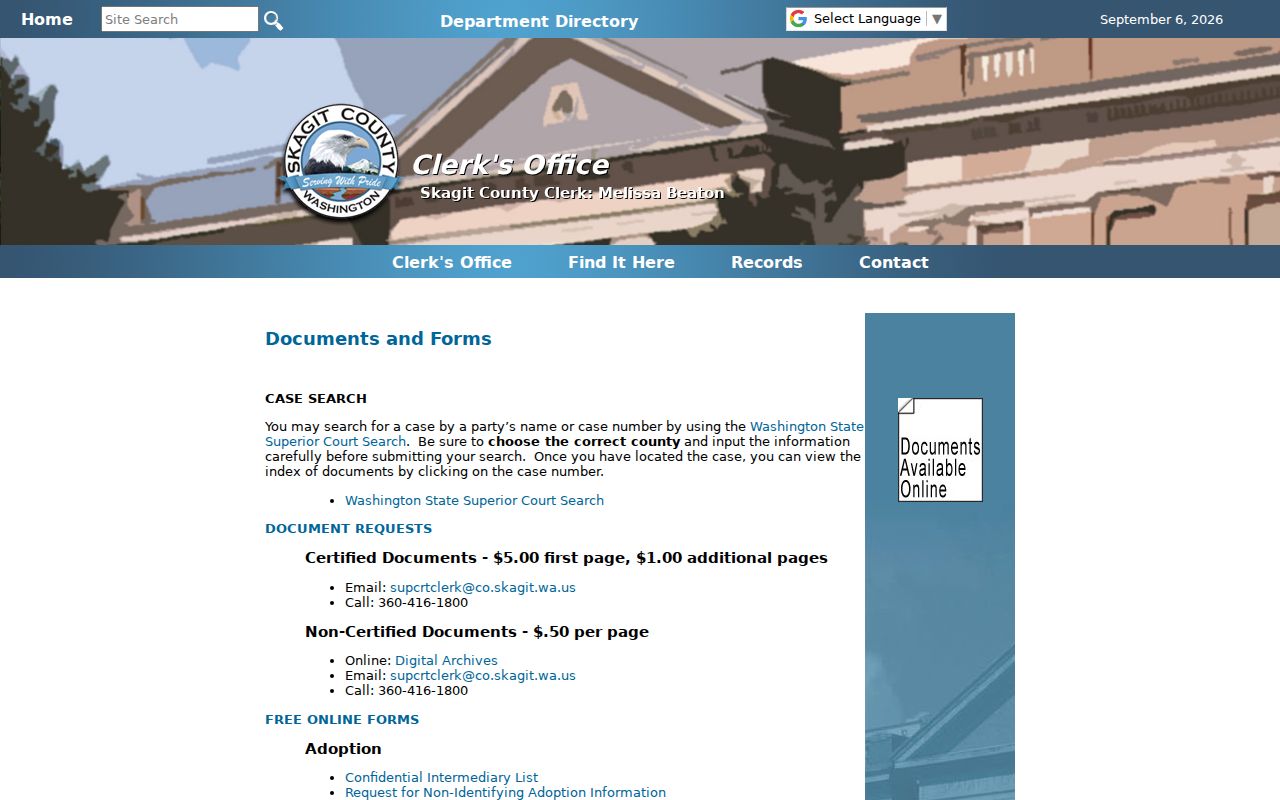
That split helps a requester use the free index to identify a filing before asking the clerk to prepare the desired copy.
What a Skagit Court Record Contains
A case file combines the chronological docket with the papers behind each entry. The public version may omit protected identifiers, sealed papers, juvenile information, or restricted family forms.
| Case Number | A unique identifier such as 99-9-99999-9. |
|---|---|
| Pleadings | Petitions, complaints, answers, and motions. |
| Orders & Judgments | Signed rulings and final decisions. |
| Docket Sheet | The dated list of filings and events. |
| Exhibits | Filed evidence, subject to access limits. |
Skagit Digital Archives Route
The County Clerk directs some non-certified documents to Washington Digital Archives. Certified copies remain a clerk service. For an older file absent from Odyssey, give the court an estimated year, party names, and case type and ask whether paper, microfilm, archive, or a legacy number applies.
District Court lists an unarchive charge of $5 for one through five cases and $10 for six or more. A broad search can also involve clerk research time. The Superior schedule lists records research at $30 per hour with a one-hour minimum. Ask for a cost estimate and retrieval plan before ordering an entire old file.
Skagit Certified Copies and Fees
A plain copy reproduces a public page. A certified copy carries the clerk's certification for uses that require official proof. Fees depend on the court and product. District Court publishes the figures below; confirm Superior and city fees before ordering. The Superior schedule also lists authenticated or exemplified copies at $9 for the first page and $2 for each added page, plus $1 for each additional seal. Staff-prepared electronic pages are $0.25 and non-electronic pages are $0.50.
| Item | Amount |
|---|---|
| District plain copy | $0.25 per page |
| District mailed copy | $0.50 per page |
| District certification | $5 first page, $1 each added page |
| Superior Odyssey images | $200 annual subscription |
Skagit County Clerk
205 W. Kincaid Street, Room 103
Mount Vernon, WA 98273
360-416-1800
Skagit Reporter Records Are Separate
Audio, video, and transcripts do not always sit in the same channel as pleadings. Identify the hearing date, judge, courtroom, and case number. Ask the clerk who recorded it and whether a court reporter, approved transcriber, or court administration handles the request.
State the format needed and whether certification is required. Recording and transcript fees differ from page-copy fees. District Court lists FTR audio duplication at $10 per CD, while the Clerk schedule lists $25 for a previously recorded courtroom video or audio CD. No reliable local transcript price was found, so obtain a quote from the reporter or transcriber. Exhibits can also follow special release rules.
Public Access to Skagit Records
Washington General Rule 31 governs court-record access. General Rule 15 covers sealing and redaction, and General Rule 22 restricts specified family and guardianship material. The Washington Public Records Act applies to agency records, not as a replacement route for court case files.
Key Rules:
GR 31 sets the public-access framework.
GR 15 governs sealing and redaction.
GR 22 protects specified family and guardianship records.
Ask for the public portion when a file contains protected data. The clerk can explain the access procedure, though only a court can grant access that requires an order.
GR 31 also means courthouse viewing itself cannot carry an access charge, though copies and staff work may cost money. GR 15 favors focused redaction when a protected identifier can be removed without sealing a whole record. GR 22 sets special limits for family and guardianship papers. Juvenile access is also shaped by RCW 13.50.050 and RCW 13.50.260. These rules explain why a public index may show less than the file held by the clerk.
For records about judicial administration rather than a filed case, GR 31.1 is the correct route. Skagit permits research charges after the first hour, up to $30 per hour, and the county launched an administrative public-records portal in early 2025. Sending a pleading request through that portal adds a detour because the court-of-record process still controls case documents.