
How to Search Civil Dockets
Use the Odyssey Portal for Skagit Superior case data. District civil and small-claims matters can be located through Washington Courts Case Search and limited-jurisdiction tools. Start with the case number when possible. A name search should use the complete party name and the likely filing period.
The result is an index, not a certified file. Confirm that the venue, parties, and case type match. Then note the exact title and filing date of any complaint, order, judgment, or dismissal needed from the County Clerk or District Court administration.
- Choose Skagit Superior, District, or the proper limited-jurisdiction court.
- Search by full party name or the complete case number.
- Match the case type, court, and filing date.
- Read entries in date order, including service, motions, settings, and rulings.
- Request the identified document from the clerk when the index is not enough.
Superior or District Civil Docket
Skagit Superior Court handles general civil claims, family cases, probate, guardianship, unlawful detainer, and other matters within its general jurisdiction. District Court handles limited civil cases and small claims. County pages conflict on whether the District civil limit is $75,000 or $100,000, so a filer should confirm the current limit with District Court before relying on either figure.
| Need | Likely court | Custodian |
|---|---|---|
| General civil or unlawful detainer | Superior Court | Skagit County Clerk |
| Limited civil claim | District Court | District Court administration |
| Small claim | District Court | District Court administration |
Small-claims limits reported in the research are $10,000 for a natural person and $5,000 for other plaintiffs. Verify the current forms and limit before filing.
The official Skagit District Court page identifies the limited-jurisdiction court and its direct access channels.
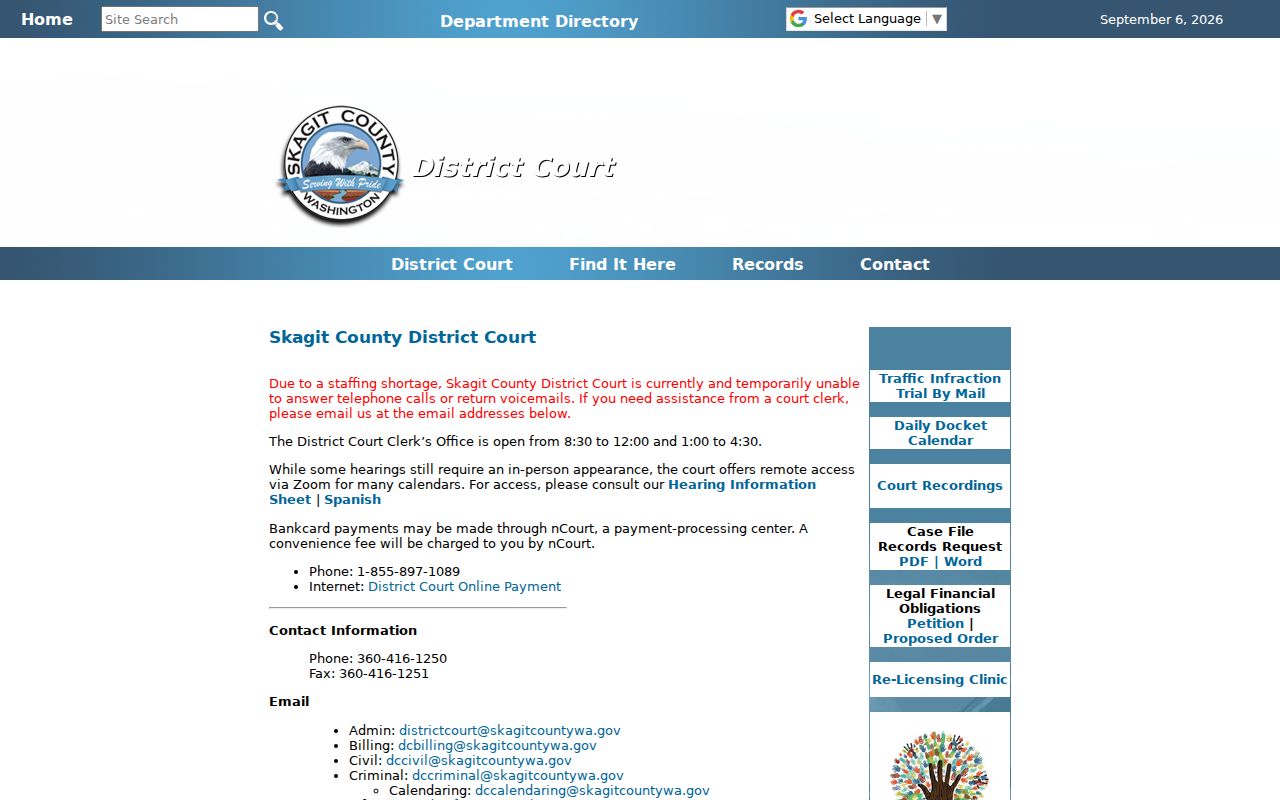
The court page helps readers route a limited civil or small-claims file without sending the request to the Superior Court clerk.
What a Civil Docket Shows
The civil docket is a chronology. It can show filing, service, answers, motions, notices, hearing dates, signed orders, and the closing event. A bare entry often summarizes rather than reproduces a document. Open or order the filed paper when wording matters.
| Case Number | The court identifier, often in a form like 99-9-99999-9. |
|---|---|
| Parties | Plaintiff, petitioner, defendant, respondent, and counsel where public. |
| Filings | Complaint, petition, answer, proof of service, declarations, and exhibits. |
| Motions | Requests for court action plus related notices and rulings. |
| Judgment | Final judgment, dismissal, agreed order, or other disposition. |
Service entries matter because the case cannot move in the same way until notice requirements are met. A motion entry does not mean the motion was granted. Look for the later signed order.
Skagit Civil Filing Sequence
A typical sequence is Complaint or Petition › Service › Answer › Motion or Scheduling Order › Hearing or Trial › Judgment. Cases can end earlier through dismissal, agreement, default, or transfer. Post-judgment entries may include an abstract, garnishment, satisfaction, or appeal.
- Default
- A result requested when a party fails to respond as required.
- Nonsuit
- A dismissal that ends the current action under the applicable procedure.
- Agreed judgment
- A judgment reflecting terms accepted by the parties and court.
- Garnishment
- A post-judgment process directed at property or funds held by another.
These labels describe procedural events. The filed order gives the controlling terms.
Types of Civil Cases on the Docket
Skagit civil records span several divisions, and public access is not identical across all of them. The County Clerk lists civil, domestic, probate, and guardianship categories in its Superior record system. District Court separately keeps its limited civil and small-claims files.
- Contract, debt, property, and tort claims
- Unlawful detainer and other general civil actions
- Domestic and family proceedings
- Probate and guardianship matters
- District civil and small-claims cases
Family and guardianship records can contain forms or data restricted by General Rule 22. A public case index does not make each filed page open to all users.
Free Skagit Index or Certified Judgment
Odyssey's free public layer supplies Superior case data. The County Clerk's paid document subscription supplies selected images for $200 per calendar year, prorated at $20 per month after January. Lobby kiosks allow free document viewing, while copies and certification carry fees.
A certified copy is issued by the clerk as an official copy. A free index entry is only evidence that an event or document was entered. District Court lists copies at $0.25 per page, mailed copies at $0.50 per page, and certification at $5 for the first page plus $1 for each additional page. Superior fees must be confirmed against the Clerk's current schedule.
The District Court fee schedule publishes copy, certification, and unarchive charges for records held by that court.
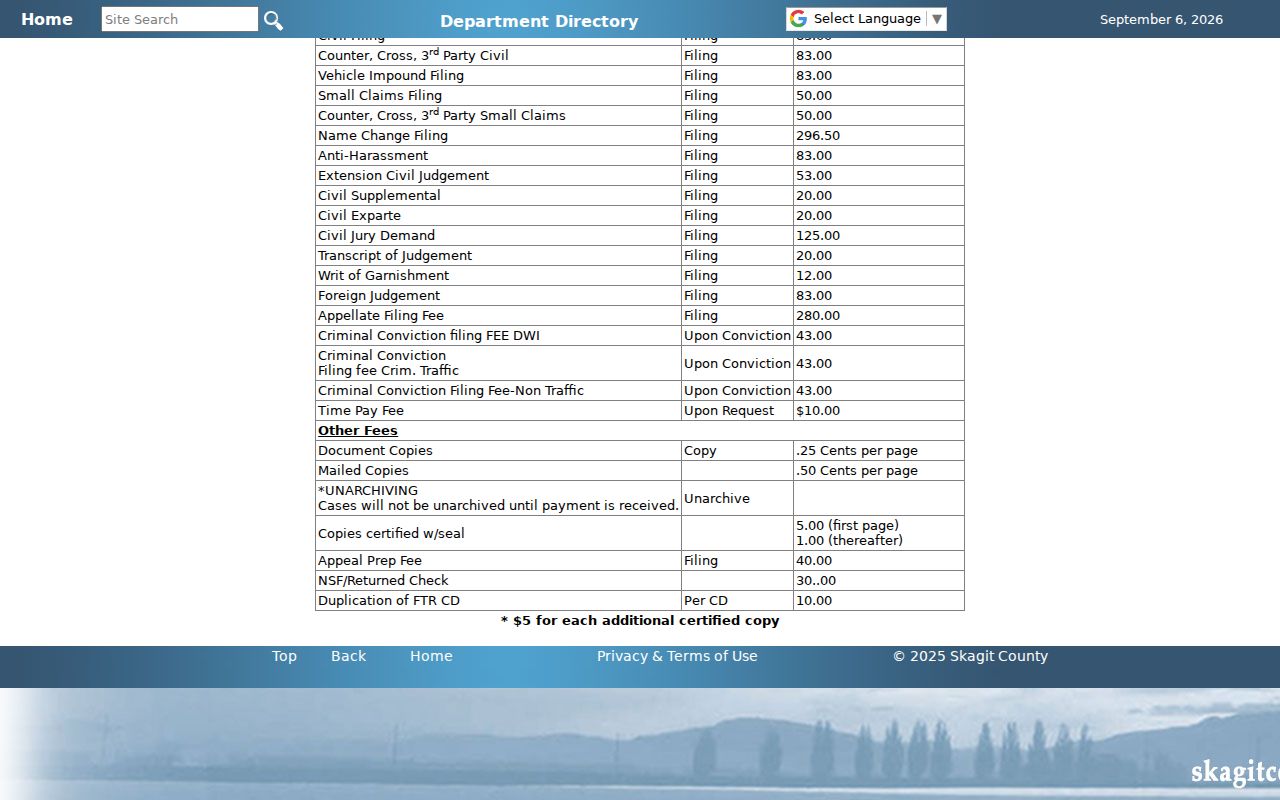
The schedule makes clear that viewing an index, receiving a plain copy, and ordering a certified civil record are distinct services.
Practical choice: use the index to identify the document, then order only the judgment or order actually needed.
Settings and Hearings on Civil Dockets
A civil setting can be a motion, status conference, settlement event, trial, or post-judgment hearing. The Daily Court Docket shows the date, court, courtroom, time, and case name. Superior Court also publishes daily and weekly calendars. A calendar row is notice of a setting, not the ruling.
Scheduling orders and local rules control deadlines. Superior dispositive motions have a published Thursday confirmation practice, so counsel and parties should check the current weekly calendar and local rules. A continuance moves an event; it does not close the case. The full Skagit County court calendar walkthrough covers date checks and clerk fallbacks.
Skagit Archives and Pre-JIS Cases
Washington's statewide search warns that older cases filed before a court joined JIS and matters with nonstandard numbers may not appear. Skagit District Court lists an unarchive charge. The County Clerk routes some non-certified documents to Washington Digital Archives and handles certified Superior requests directly.
If an older civil case is missing, give the clerk party names, an estimated year, case type, and any number found on a paper order. Ask whether the file is archived, on paper, microfilm, or held by another court. Search time and retrieval fees can apply, so obtain a quote before ordering a broad file.
Do not infer that an absent web result means the case never existed. The court of record can explain its archive and access process.
Skagit District Response Channels
District civil files stay with District Court administration. The published contact is dccivil@co.skagit.wa.gov, and the counter is in the Larry E. Moller Public Safety Building. Phone, email, and in-person access are useful when a search result is old, a file must be unarchived, or a party needs the exact copy charge.
The District Court response page illustrates how that court publishes direct mail, counter, and remote procedures apart from Superior Court systems.
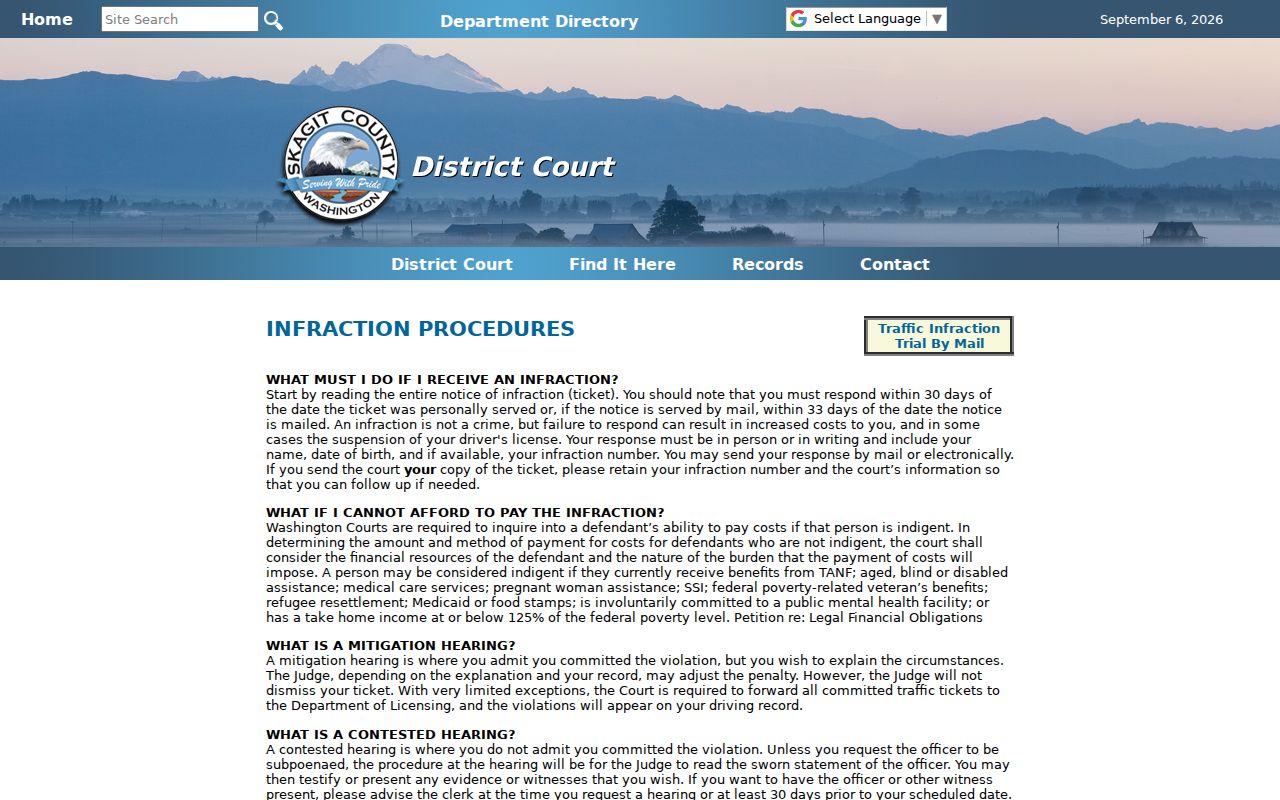
Although its main subject is infractions, the screenshot reinforces the local rule that District Court uses its own clerk channels and calendar tools.
Public Access to Civil Dockets
Washington General Rule 31 governs access to court records, while General Rule 15 covers sealing and redaction. General Rule 22 adds limits for family-law and guardianship records. The Washington Public Records Act serves agency records, but a judicial case file must be requested through the court custodian under the court rules.
Key Rules:
General Rule 31 sets the court-record access framework.
General Rule 15 governs sealing and redaction.
General Rule 22 restricts specified family and guardianship material.
Request the public portion if a document contains protected data. The clerk may redact a page or require a court order for access. Administrative records follow GR 31.1 and the county public-records channel, which is separate from civil case-file access.